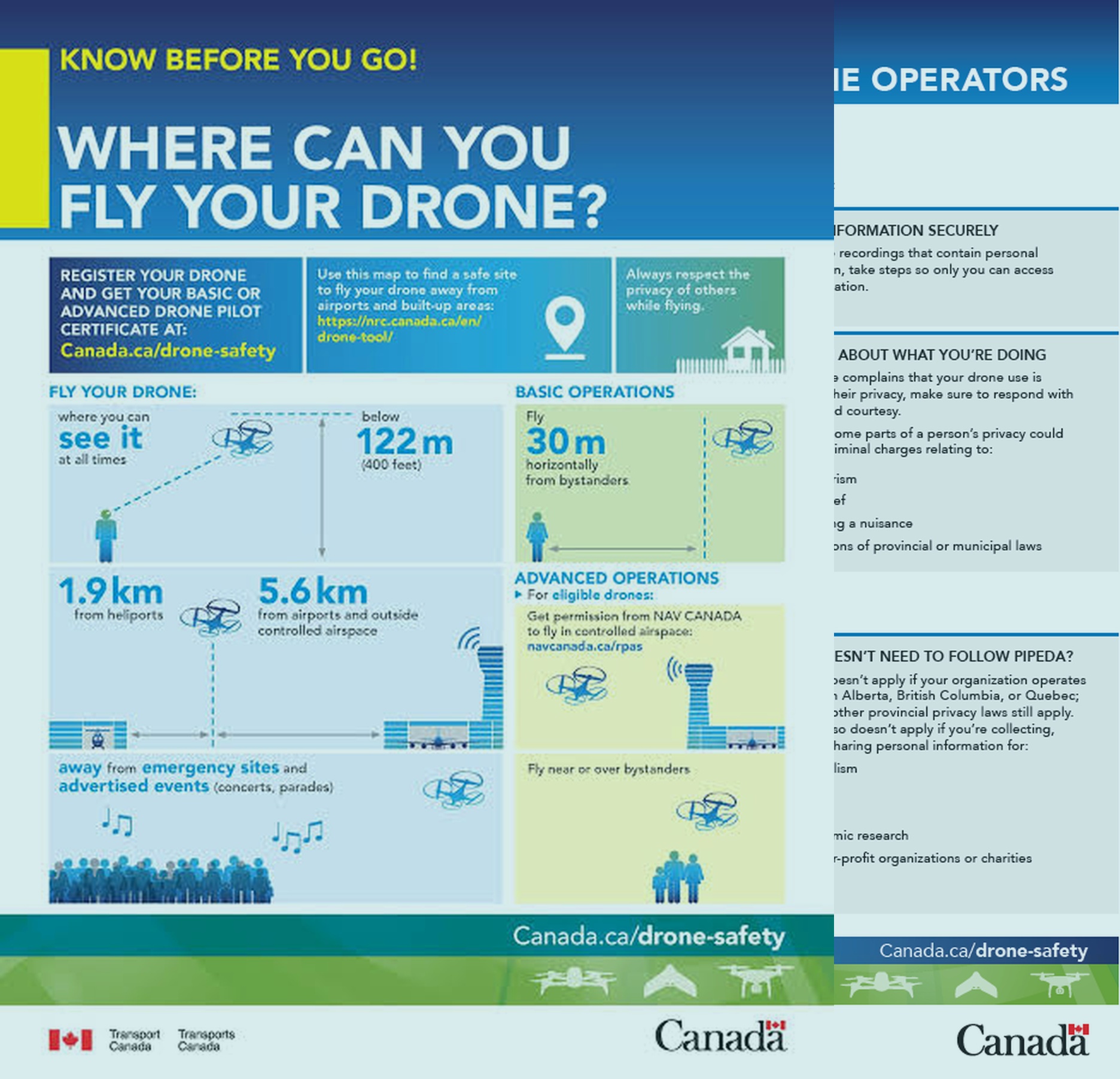
Useful information for RPAS operations in Canada.
Canadian drone rules are written in aviation language. Most people who commission drone work in insurance are not aviation people. This glossary is for them. Also included are a summary of DSC’s services and links to further reading.
This is a plain-language guide, not legal or regulatory advice. The authoritative texts are the Canadian Aviation Regulations and the standards under them. Building a program or writing a procedure against these terms? Talk to the people who fly this stuff.
Scope. DSC flies remotely piloted aircraft of 25 kg operating weight or less, so that is the band covered here: under 250 g, and 250 g up to 25 kg. Heavier classes appear only to mark the boundary. Different rules apply when you cross 25 kg.
Alphabetical glossary
A
Above ground level (AGL) — Altitude measured from the ground directly beneath the aircraft, not sea level. Drone ceilings are given in AGL.
Advanced operations — Everything outside the Basic envelope: controlled airspace, closer than 30 m to uninvolved people, within 5.6 km (3 NM) of a certified airport or 1.9 km (1 NM) of a heliport, sheltered operations, EVLOS, medium-aircraft VLOS. Needs an Advanced certificate and, for most sub-types, the matching declaration. (CARs 901.62–901.75)
Aerodrome — Any area of land or water used for the arrival, departure or movement of aircraft. Broader than airport; it takes in unpaved and private strips. Canada Flight Supplement.
Air traffic control (ATC) — NAV CANADA, or DND at military aerodromes. Its authorization is what gets a drone into controlled airspace. (CARs 901.71)
Airspace classes — Classes A through G. A to E are controlled, G is uncontrolled, and Class F is special-use airspace, restricted or advisory, that can sit inside either. Basic operations are confined to Class G.
B
Basic operations — The entry-level category: a small aircraft, VLOS, uncontrolled airspace, and more than 30 m horizontally from anyone not involved, 5.6 km (3 NM) from a certified airport centre, 1.9 km (1 NM) from a heliport centre. Miss one and the flight is Advanced or higher. (CARs 901.47(2), 901.53–901.59)
Bystander — Informal shorthand for what the regulations call a person not involved in the operation. Distances are measured to them, and the line matters. A briefed, consenting homeowner is not a passerby.
C
Canadian Aviation Regulations (CARs) — Aviation regulation made under the Aeronautics Act. Drones are aircraft in Canadian law, which is why any of this applies.
CARs Part IX — Remotely Piloted Aircraft Systems, the part carrying most drone-specific rules (CARs 900.02). Per Transport Canada guidance it stops at the door: indoor and underground flying fall outside.
Controlled airspace — Airspace of defined dimensions in which ATC service is provided. A drone gets in under Advanced operations with an air traffic services authorization, otherwise only under an SFOC. (CARs 901.14, 901.71)
Crew member — Anyone assigned to duty on an RPAS operation during flight time: usually the pilot and any visual observer. Each must be instructed on their duties before acting. (CARs 101.01, 901.28)
D
Drone Management Portal — Transport Canada’s system for registration, exams and pilot certificates.
Drone Site Selection Tool — A National Research Council map of where flight is prohibited, restricted or hazardous. An aid, not an authorization.
E
Extended visual line-of-sight (EVLOS) — Not in visual line-of-sight, but unaided visual contact is held with the airspace the aircraft is in, enough to spot conflicting traffic and hazards and avoid them. Small aircraft: uncontrolled airspace only, 30 m from uninvolved persons, within 3.7 km (2 NM) of the pilot, control station and observer. Advanced certificate, plus an observer holding at least a Basic one. (CARs 900.01, 901.62(b), 901.74–901.75)
F
Flight review — The practical assessment behind the Advanced and Level 1 Complex certificates, conducted by a holder of the flight reviewer rating (CARs 901.176). It also counts toward recency. (CARs 901.64(c), 901.90(e), 901.181). Contact DSC if you require a flight review.
Fly-away — Loss or interruption of the command and control link, leaving the pilot unable to control the aircraft while it no longer follows its preprogrammed procedures or behaves predictably. One of the occurrences that stops an operation on the spot. (CARs 900.01, 901.49)
G
Gimbal (industry) — The stabilized mount carrying the camera. Its quality decides whether close-range damage imagery is usable.
Ground sample distance (GSD) (industry) — The real-world size of one image pixel, usually in millimetres. Whether you can count hail impacts comes down to this number.
H
Heliport — An aerodrome for helicopters. Basic operations stay 1.9 km (1 NM) clear of the centre.
Horizontal distance — The gap between aircraft and a person not involved, measured horizontally at any altitude. Outside Advanced operations: 30 m for a small aircraft, 152.4 m (500 ft) for a medium one. What separates Basic from Advanced. (CARs 901.26)
I
Incidents and accidents — Seven occurrences force an immediate stop: injury needing medical attention, contact between aircraft and persons, damage affecting flight characteristics, straying outside altitude or horizontal limits, collision or near-collision, a fly-away or an uncontrollable or missing aircraft, and anything drawing a police report or Occurrence Report. Resume once the cause is analyzed and corrected; keep that analysis for 12 months. (CARs 901.49)
L
Large remotely piloted aircraft (industry) — Over 150 kg. Not a defined term in the CARs; the operative rule is that flying one takes an SFOC. (CARs 903.01(a)). Outside DSC scope.
M
Maximum altitude — 122 m (400 ft) AGL. Within 61 m (200 ft) horizontally of a building or structure, you may climb to 30 m (100 ft) above that structure. Anything higher takes an SFOC. (CARs 901.25)
Microdrone (industry) — Under 250 g. Transport Canada’s term, and not one the CARs define. No registration, no marking, no pilot certificate. Safety rules, airspace restrictions and the advertised-event SFOC still apply, so unregistered is not unregulated. And watch the weight: it includes everything attached, so a camera, lens filter, or cage can push you over.
N
NAV CANADA — Canada’s civil air navigation service provider, and issuer of RPAS Flight Authorizations in the airspace it controls. DND does the same for military airspace.
NAV Drone — NAV CANADA’s app and web tool for checking airspace, planning flights and requesting controlled-airspace authorization.
NOTAM (Notice to Airmen) — Notices of temporary airspace restrictions, events and hazards. Checking them is part of the site survey. (CARs 901.27)
NM — Nautical Mile. A nautical mile equals 1.85 kilometers or about 1.15 statute miles. The term is used by pilots and air traffic control to measure distances in the sky.
O
Operating weight — What the aircraft weighs at any point in a flight, payload and any safety equipment on board or otherwise connected included. The control station is separate, so the controller does not count. Anything the aircraft carries does. This sets the weight class. (CARs 900.01)
Orthomosaic (industry) — One geometrically corrected image assembled from overlapping photos, so distances measured on it are true. Wide-area CAT triage imagery is built on it.
P
Photogrammetry (industry) — Deriving measurements and 3D geometry from overlapping photographs. It is what drives a roof measurement report.
Pilot certificate — Transport Canada’s authorization for a category of operation: Basic (age 14 and up), Advanced (16), Level 1 Complex (18). Certificates do not expire; recency does. Both must be easily accessible in flight. (CARs 901.54–901.57, 901.63–901.66, 901.89–901.90)
Pilot-in-command — The pilot responsible for the operation and safety of a flight. An RPAS operator designates one for each Level 1 Complex operation. (CARs 901.222)
PIPEDA — The Personal Information Protection and Electronic Documents Act. Not aviation law, but it governs how imagery and personal information gathered on an inspection may be handled. Provincial statutes can apply too.
R
Registration — Every aircraft of 250 g or more operating weight must be registered before it flies, the number clearly visible on the airframe; marker, label or engraving all pass. The certificate must be easily accessible to the pilot throughout. Unregistered costs a corporation up to $25,000; unmarked, $15,000. (CARs 900.13, 900.14, 900.16, 900.20)
Remotely piloted aircraft system (RPAS) — The configurable set of elements making up the aircraft, its control station, the command and control links and anything else required in flight. The regulator’s term; drone, UAV and UAS are colloquial equivalents. (CARs 101.01)
Right of way — A drone pilot gives way to power-driven heavier-than-air aircraft, airships, gliders and balloons at all times. No exceptions. (CARs 901.17)
RPAS operations manual — The manual an RPAS operator must establish and maintain (CARs 901.217). Separate from the manufacturer’s operating manuals, which must also be immediately available to crew at take-off. (CARs 901.30, 901.31)
RPAS Operator Certificate (RPOC) — The organizational certificate introduced in 2025. Level 1 Complex operations may only be flown by an RPAS operator, or its employee, agent or representative, on the conditions in the certificate. It brings an operations manual, documented processes, training, maintenance and record-keeping. The approval attaches to the organization, not the individual. (CARs 901.88, 901.213 and following)
S
Special Flight Operations Certificate – RPAS (SFOC-RPAS) — Permission to operate outside the three standard categories. The regulations grade applications into four tiers; two cover most commercial work. Medium: over 150 kg, above 122 m (400 ft), more than five aircraft at once in VLOS or more than one otherwise, unregistered aircraft in commercial service, foreign operators. High: BVLOS beyond the lower-risk regime, restricted payloads, BVLOS within 9.3 km (5 NM) of a listed aerodrome, BVLOS or medium-VLOS in sub-minimum weather, a person on board. Advertised events and drone shows need one too. (CARs 903.01–903.04)
Site survey — The mandatory pre-flight assessment of whether the operational volume is suitable, covering airspace type and any NOTAM; approach, take-off, launch, landing and recovery altitudes and routes; nearby aircraft operations, airports, heliports and aerodromes; obstacles and their height, wires, masts, buildings, cell towers and wind turbines included; weather and forecast; distance from uninvolved persons; and, for BVLOS, from populated areas. (CARs 901.27)
Small remotely piloted aircraft — At least 250 g (0.55 pounds) but not more than 25 kg (55 pounds). (CARs 900.01). The category DSC operates in.
T
Test square (industry) — A defined area of roof surface, conventionally 10 ft by 10 ft, in which hail impacts are counted to gauge damage density.
Thermal imaging (industry) — Infrared capture that finds apparent temperature differences suggesting trapped moisture. Radiometric data keeps per-pixel temperature values; non-radiometric does not.
Transport Canada Civil Aviation (TCCA) — The Transport Canada branch that regulates civil aviation, RPAS included.
U
Uncontrolled airspace — Class G. No ATC service provided. Where Basic operations live.
V
Visual line-of-sight (VLOS) — Unaided visual contact with the aircraft, enough to keep control, know where it is, and scan the airspace for conflicting traffic and hazards in time to avoid them. Unaided is the word that matters: binoculars and FPV goggles do not count. (CARs 900.01, 901.11)
Visual observer (VO) — A crew member trained to assist the pilot in the safe conduct of a flight. Reliable, timely communication has to hold throughout. A VO may not watch more than one aircraft at a time in most cases, and never while driving or operating a vessel. (CARs 900.01, 901.20)
W
Weather minimums — The conditions under which a flight may proceed. For VLOS, the weather must let the operation run per the manufacturer’s manuals and the pilot or observer hold visual line-of-sight throughout. (CARs 901.34)
Addendum: DSC’s four service models
Where our pilot network and your in-house team intersect.
1. Fly: We fly your inspections
Certified, insured DSC pilots take single-risk assignments and full catastrophe deployments Canada-wide. Aircraft go out within days and the property is flown in one visit. No second trip. No waiting on a roofer. What comes back is claim-ready: photo sets by slope and elevation, a roof measurement report with facets, pitch and total squares, hail and wind damage close enough to count impacts, thermal where moisture is in question. The benefit is not really the aircraft. It is your adjusters spending their time on decisions instead of drive-time, and the cashout-versus-vendor call made early, on evidence.
2. Build & Train: We build and train your in-house drone team
Want the capability on your own payroll? DSC builds the department with you. Pilot selection, equipment, operating procedures, Transport Canada compliance, record-keeping, dispatch design, a storm-surge plan. Then ground school, exam prep and official flight reviews, online at your team’s pace or on site, taking people from interested to certified to flying real claims. Consistency here is evidential. When every pilot captures the same way, every file reads the same way and the documentation holds up.
3. Dispatch & Surge: One queue, every pilot, storms included
Most clients end up wanting both models, so we fold your pilots and ours into one dispatch queue. Your team flies when they are nearby and available. DSC absorbs the distance, the awkward timing and the volume. That matters in the weeks that break everything else. In the 2024 Calgary hailstorm, with roughly one home in five damaged, we completed 2000+ assignments across multiple clients at a seven-day average from assignment to scan. Surge capacity is what keeps cycle times and service commitments intact when the volume arrives all at once.
4. VeriFly: Track how cashouts are resolved
A cash settlement closes the file. It does not close out the roof. Once the cheque is issued you have no way of knowing whether the damage was ever repaired, and every unrepaired roof is a latent liability and an underwriting blind spot sitting on the book. VeriFly replaces pay-and-forget with a follow-up inspection on a timeline you control: send the assignment one to three months after the cashout, DSC flies the roof and delivers the imagery, you verify whether repair or replacement happened. After a severe CAT event, when contractor capacity is stretched, extend the gap.
Useful Links
Canadian Aviation Regulations (SOR/96-433), Part IX — Remotely Piloted Aircraft Systems
SOR/2025-70, the 2025 amending regulations (Canada Gazette Part II)
Transport Canada — 2025 summary of changes to Canada’s drone regulations
Transport Canada — Basic, Advanced and Level 1 Complex operations
Transport Canada — Special drone operations (SFOC-RPAS)